A modern smartphone is arguably the most sophisticated object most people own. It contains a substantial fraction of the periodic table, assembled at tolerances measured in nanometres, in a package small enough to fit in a pocket and durable enough to survive years of daily handling.
Every one of those achievements makes it harder to take apart. The design decisions that produce a thin, waterproof, structurally rigid device are precisely the decisions that make component separation difficult, and the recycling industry has been working against that trend for the better part of two decades.
This is worth understanding because it explains why old cell phone recycling recovers a smaller share of the material than most people assume, and why keeping a phone in service or passing it on intact is a substantially better outcome than sending it for material recovery, even when the recovery is done well.
What Is Actually Inside
The material inventory of a smartphone is remarkable for its diversity rather than its quantity.
Somewhere between fifty and sixty distinct elements are typically present. Gold, silver, palladium, and platinum appear in connectors, contacts, and component packaging. Copper forms the interconnect throughout. Aluminum and sometimes stainless steel form the frame.
Rare earth elements appear in several places: neodymium and dysprosium in the speaker and vibration motor magnets, and various others in the display and in colour conversion layers. Cobalt and lithium sit in the battery. Tantalum appears in capacitors. Indium is used in the touchscreen conductive layer.
The quantities are individually tiny. A single phone contains a fraction of a gram of gold and correspondingly small amounts of everything else. It is only at aggregate scale that the numbers become meaningful, and that aggregation is the first practical obstacle.
Why Small and Dense Is Difficult
Recovery processes work best on material that can be separated into clean streams. Phones resist this at every stage.
Adhesive assembly is the primary obstacle. Displays are bonded rather than clipped, batteries are glued into place, and structural components are held with adhesive that must be heated or cut to release. What takes seconds on a serviceable device takes minutes on a bonded one, and labour is the dominant cost in disassembly.
Miniaturization compounds it. Components are packed at densities that leave no separation margin, and elements present in milligram quantities are distributed across multiple components rather than concentrated anywhere.
Material mixing at microscopic scale is the deepest problem. Modern components combine metals in alloys and layered structures that cannot be separated mechanically at all, only chemically, and only economically at large volume.
The result is that shredding a phone produces a mixed stream from which the bulk metals can be recovered but many of the trace elements cannot. Rare earths in particular are frequently lost, not because the technology to recover them does not exist, but because the concentrations after shredding are too low to process economically.
The Battery Complication
Lithium cells make the process harder before it starts.
Glued batteries must be removed manually, and removal is delicate because a punctured or crushed cell can ignite. This single requirement means phones cannot go into automated processing without a manual step first, which sets the labour floor for the entire operation.
Battery recovery is improving. Lithium and cobalt recovery has become economically viable as demand from vehicle manufacturing has driven investment in processing capacity, and the same infrastructure serves consumer cells.
But the manual removal requirement remains, and it is why phone processing costs more per unit than almost any other consumer electronic category relative to the material recovered.
Why Reuse Matters More Here Than Anywhere Else
The difficulty of recovery is the strongest possible argument for keeping phones in service.
A phone that stays in use for two additional years defers an entire manufacturing cycle, which represents around eighty percent of the device’s lifetime emissions and all of the extraction impact. No recovery process comes close to matching that.
Passing a working phone to another user achieves the same thing. Devices that are two or three years old are entirely capable for most purposes, and the secondary market for them is large and functioning.
Battery replacement is the intervention that most often extends life, since a degraded battery is the most common reason a functioning phone is retired. Replacement costs a fraction of a new device and restores the experience that made it feel obsolete.
Repair for cracked screens is similarly economic on most models, and the availability of parts is improving as repairability requirements enter regulation in several jurisdictions.
What This Means for Your Old Handsets
The order of preference follows directly from the difficulty of recovery.
Keep the device in service if it still works and the battery can be replaced. Pass it to another user if you no longer need it and it functions. Trade it in if it holds value, since trade-in feeds the refurbishment market rather than the shredder. Send it for material recovery only when it is genuinely finished, meaning damaged beyond economic repair, locked to an unrecoverable account, or too old to receive security updates.
Preparation matters at every one of those steps. Back up, sign out of accounts explicitly, remove the device from account locks, remove the SIM and any memory card, and then factory reset. Skipping the account release step is the single most common reason a perfectly good handset ends up in the recovery stream instead of back in use.
The Direction This Is Moving
Design is beginning to change under regulatory pressure. Repairability scoring, parts availability requirements, and rules on battery replaceability are being introduced in several jurisdictions, and they will eventually produce devices that come apart more easily.
Recovery technology is improving in parallel, particularly for battery materials where demand has justified investment.
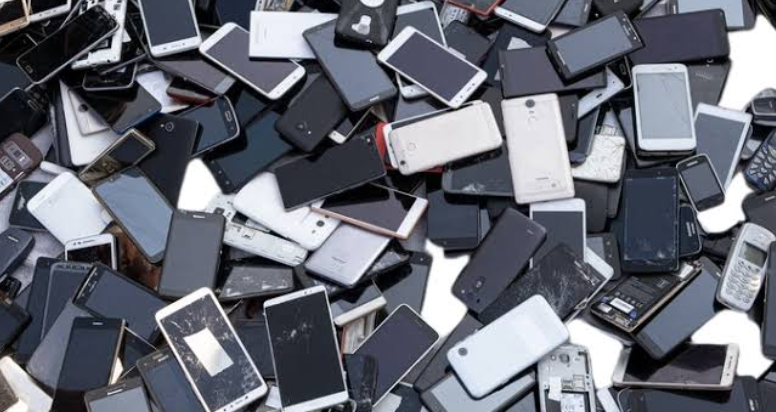
Neither of those helps with the handsets already in circulation, and there are billions of them sitting unused. For those, the useful action is the simple one: get them out of drawers, back into use where possible, and into a documented recovery stream where not. The material is genuinely difficult to recover, which is exactly why the devices that can still be used are worth more in someone’s hand than in any shredder.